On this page, we help students to answer the following question: “What is interpersonal conflict?” This is for Life Orientation Grade 12 Term 1 Source-Based Task 2026.
Quick Answer
Interpersonal Conflict Defined: * External Clash: A disagreement or struggle between two or more people. * The Parties: Usually involves peers, teachers, family members, or colleagues. * The Cause: Differences in interests, goals, values, or opinions.
- The Goal: Resolved througheffective communicationand negotiation.
Full Answer: Understanding Interpersonal Conflict in Life Orientation
In the Grade 12 Life Orientation curriculum, interpersonal conflict is identified as an external social dynamic that occurs when the needs or ideas of one person clash with those of another. Unlike intrapersonal conflict, which is a struggle within one’s own mind, interpersonal conflict involves multiple parties and requires social skills to resolve.+1
1. Who is Involved in Interpersonal Conflict?
Interpersonal conflicts occur in any social setting where humans interact. For a matric learner, these struggles most commonly happen with:+1
- Peers: Disagreements over social influence or peer pressure .
- Teachers: Clashes over academic deadlines, classroom rules, or study methods.+1
- Family Members: Tensions regarding household responsibilities or financial decisions.+1
2. Common Triggers for Matriculants
Several factors can ignite interpersonal conflict during the final school year:
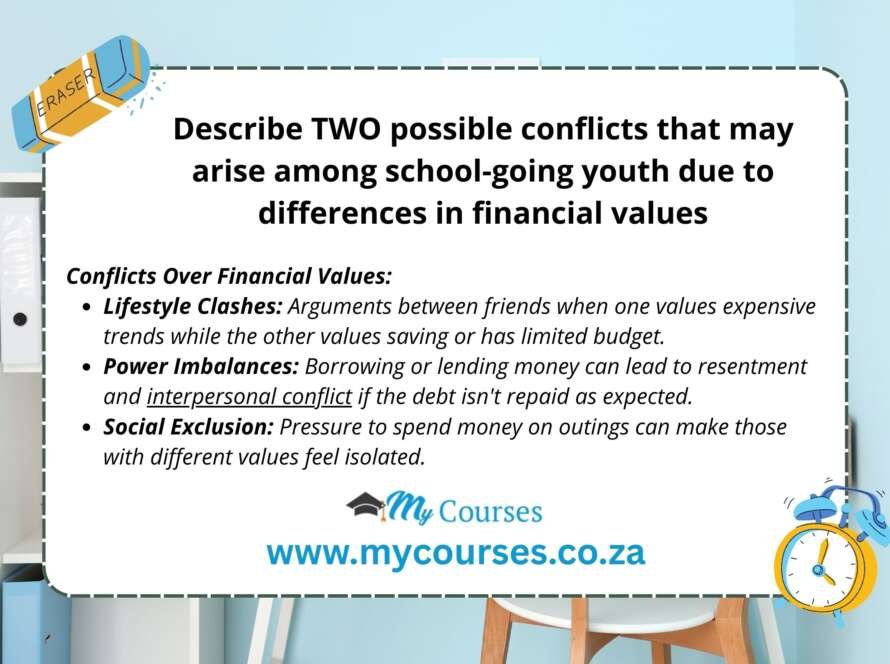
- Differences in Financial Values: Disagreements with friends or family about how to spend money or fund tertiary studies.
- Social Influences: Feeling pressured to adopt certain behaviours or personal values that align with a peer group rather than oneself .
- Communication Breakdowns: A lack of effective communication can turn a small misunderstanding into a major argument.
3. The Impact of Unresolved Conflict
If a matric learner tries to avoid conflict rather than resolving it, the consequences can be severe:
- Emotional Stress: Unresolved arguments cause long-term stress and uncertainty.
- Detrimental Relationships: Prolonged conflict leads to relationships that are harmful to well-being.
- Academic Decline: Preoccupation with social drama makes it difficult to stay focused when writing exams .
4. Resolving Interpersonal Conflict
To maintain a healthy quality of life, learners should adopt conflict resolution skills:
- Appropriate Expression: Learning to express views in an appropriate manner without resorting to insults.
- Active Listening: Hearing the other person’s view before reacting to ensure understanding.
- Negotiation: Parties talk directly to reach a compromise that satisfies both sides.
Reference for Students:
- Subject: Life Orientation Grade 12
- Textbook: Focus Life Orientation Grade 12
- Chapter: Chapter 1: Development of the Self in Society (Unit 2: Conflict Resolution).
Get Free Help for Your Assignment Today
Click the Button Below: