This page contains a list of all possible Life Orientation Grade 12 2026 Source-Based Task Term 1 Questions and Answers to help students prepare and pass their term 1 assessments. The compilation includes the Western Cape list of questions as well as general national Life Orientation Grade 12 2026 Source-Based Task Term 1 Questions and Answers.
Section 1: Study Skills and Stress Management
- Define the term stress management as an important skill that grade 12 learners should have to effectively go through the challenges of this exit grade.
- List four effective study methods a matric learner could implement to optimise their preparation for the nsc exams.
- Define the concept stress.
- Differentiate between social and environmental factors that may cause stress to grade 12 learners as they transition from grade 11.
- Evaluate the importance of having effective coping mechanisms to manage stress .
- Explain two ways a grade 12 learner can identify if they are suffering from excessive stress.
- Evaluate own ability to prevent stress.
- Signs and symptoms of stress.
- Define the term stress.
- What is stress.
- Define the term stress as it could be experienced by matriculants in school.
Section 2: Career Pathing and Higher Education
- Define the term admission requirements to higher education institutions.
- Briefly state FOUR reasons why learners find it difficult to be admitted to higher education institutions.
- Differentiate between the National Benchmark Test (NBT) and Admission Point Scores (APS), as required by tertiary education institutions.
- Describe how a career portfolio could be beneficial to a grade 11 learner who is approaching the exit grade.
- Explain why grade 11 learners should use the Khetha document for career pathing.
- Discuss why grade 11 learners should have more than one career option for their career paths.
- Analyse the negative effects of an inability to explore tertiary education financial assistance while still in grade 11.
- Critically discuss why most grade 11 learners may not be interested in pursuing their studies at TVET Colleges.
- Assess why SETAs may be the preferred option for the South African.
- Suggest four strategies that the department of higher education and training can put into place to create more interest in trade and vocational professions.
- Define the term career decision making.
- Differentiate between a job and an occupation.
- Discuss the benefits of goal setting on your career choice.
- Describe how personal values may help you with goal setting.
- What is goal setting?
- Define goal setting in life orientation.
- Define the term goal setting in life orientation.
- Analyse how researching appropriate funding options may help a matric learner to plan financially for further studies.
- Explain the importance of obtaining national senior certificate.
- Explain the importance of obtaining a national senior certificate.
- Discuss why networking is important for career advancement and how you can start building connections.
- Define the term unemployment.
- Name and discuss two ways of funding tertiary education.
Section 3: Relationships and Communication
- Critically discuss the impact of the media on beliefs about relationships.
- Explain factors that may contribute to relationships that are detrimental to well being.
- Give a full explanation of detrimental relationships.
- Define the term power relations.
- Explain two elements that influence effective communication in any relationship .
- Explain how power relations can lead to teenage pregnancy.
Section 4: Conflict Resolution and Transitions
- Discuss two ways in which unresolved interpersonal conflict can cause emotional stress for a teenager.
- Define transition in the context of growth and change.
- Examine how having a shy personality might cause a person to miss out on two potential job opportunities during the application or interview process.
- Discuss three ways in which interpersonal conflict can intensify stress.
- Define interpersonal conflict.
- Distinguish between interpersonal conflict and intrapersonal conflict.
- What is conflict resolution.
- What is interpersonal conflict.
- Differentiate between interpersonal conflict and intrapersonal conflict.
- Conflict resolution meaning.
- Differentiate between interpersonal conflict and intrapersonal conflict which a matric learner could experience.
- State two factors that might make the changes during matric challenging or intimidating for certain learners .
- Difference between interpersonal and intrapersonal conflict.
- What is intrapersonal conflict.
- Discuss the possible negative impact that avoiding conflict may have on a matric learner’s emotional well-being.
Section 5: Human Rights and Social Responsibility
- Differentiate between discrimination and human rights violation.
- Differentiate between fair discrimination and unfair discrimination.
- Differentiate between discrimination and gender inequality.
- Critically discuss why it is important for people to express their views in an appropriate manner in a democratic country like south africa.
Section 1: Development of the Self in Society
- Describe TWO possible conflicts that may arise among school-going youth due to differences in financial values.
- Explain THREE innovative strategies that a matric learner could apply to achieve financial independence while still at school.
- Assess how stress caused by peer pressure can impact the quality of life of a matric learner.
- Evaluate how taking a gap year may affect a matric learner’s stress levels compared to starting tertiary studies straight after the NSC examinations.
Section 2: Study Skills
- Analyse TWO exam-writing strategies that could help a matric learner manage stress to maintain focus during an examination.
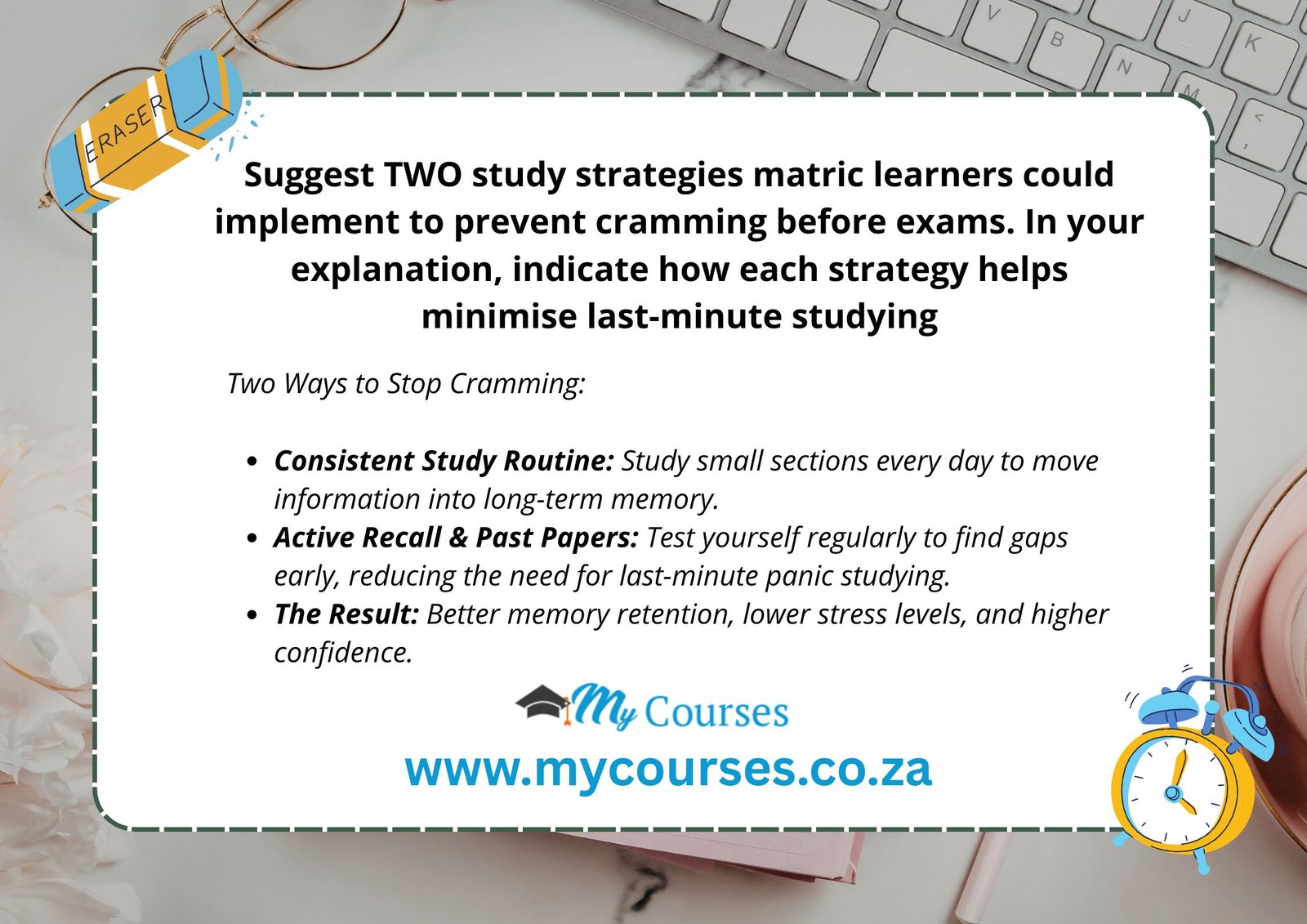
- Suggest TWO study strategies matric learners could implement to prevent cramming before exams. In your explanation, indicate how each strategy helps minimise last-minute studying.
Section 3: Careers and Career Choices
- Distinguish between fraud and corruption.
- Discuss the impact that corrupt practices within a government may have on the society it is meant to serve.
- Analyse how accepting corruption as normal could negatively affect the moral conduct of young people in the country.
- Critically discuss how the young people in the country could be a powerful force in the fight against corruption.
Get Free Help for Your Assignment Today
Click the Button Below: