
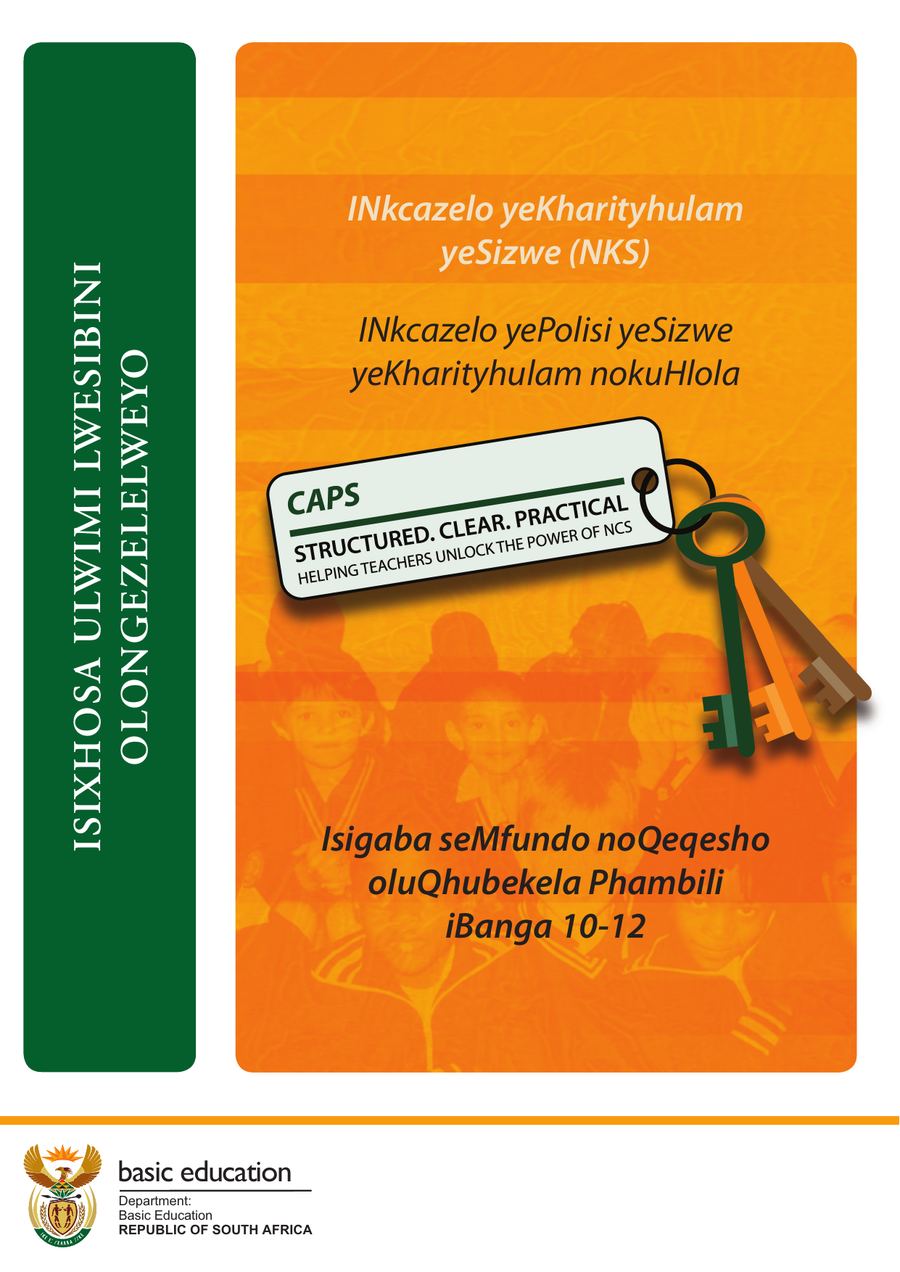
isiXhosa Second Additional Language CAPS Document Grades 10-12 kavo-051

This is the isiXhosa Second Additional Language CAPS Document (Curriculum and Assessment Policy Statement) for the Further Education and Training (FET) Phase, Grades 10-12, issued by the South African Department of Basic Education. It sets out what must be taught, learnt and assessed in isiXhosa Second Additional Language across Grades 10, 11 and 12, and is relevant for the 2026 and 2027 school years. The subject develops the language skills of listening and speaking, reading and viewing, and writing and presenting, together with language structures and conventions. The document is a translated version of the generic Second Additional Language CAPS and is presented largely in isiXhosa, with the cover and disclaimer pages in English confirming the subject and phase.

The following document, isiXhosa Second Additional Language CAPS Document Grades 10-12.pdf, is the full document.

CAPS Document Brief

isiXhosa Second Additional Language CAPS Document Grades 10-12 kavo-051

isiXhosa as a Second Additional Language is defined as a further language learnt beyond a learner’s home language and first additional language, enabling broader communication and multilingualism. As with all Second Additional Language documents, the curriculum assumes learners do not necessarily have prior knowledge of the language and focuses on developing basic interpersonal communication skills before building literacy.
The document runs to 102 pages and is organised into four sections following the same structure as the generic Second Additional Language CAPS: Section 1 introduces the CAPS policy in general, Section 2 introduces the languages and the specific aims of learning additional languages, Section 3 sets out content and teaching plans for listening and speaking, reading and viewing, and writing and presenting, with detailed teaching plans for each grade, and Section 4 covers assessment, examinations, recording, reporting and moderation, followed by a glossary.
Learning isiXhosa as a Second Additional Language aims to enable learners to acquire the language skills needed to communicate appropriately, and to listen, speak, read and write with confidence and enjoyment. It also aims to develop learners as independent thinkers who can express their own ideas, access and manage information, and use the language for critical and creative thinking.
Grade 10-12
Subject isiXhosa Second Additional Language
Phase Further Education and Training (FET)
Curriculum South African (CAPS)
School Years 2026 and 2027

isiXhosa Second Additional Language CAPS Document Grades 10-12 kavo-051