
Music Grade 12 Exam Guidelines Scope 2026

On this page, you will find the Grade 12 Music Exam Guidelines and Scope for 2026. This is the guide that tells you what you need to focus on for your exam preparations. As you go through the document, you will see that Music Grade 12 is made up of three components: a practical performance exam and two written papers, Paper 1 and Paper 2. The practical exam is conducted between August and October. Paper 1 focuses on music literacy and general music knowledge, covering theory, composition, and one chosen stream, either Western Art Music, Jazz, or Indigenous African Music. Paper 2 focuses on music comprehension, testing your listening skills through an aural exam.

Music Grade 12 Exam Guidelines and Scope PDF

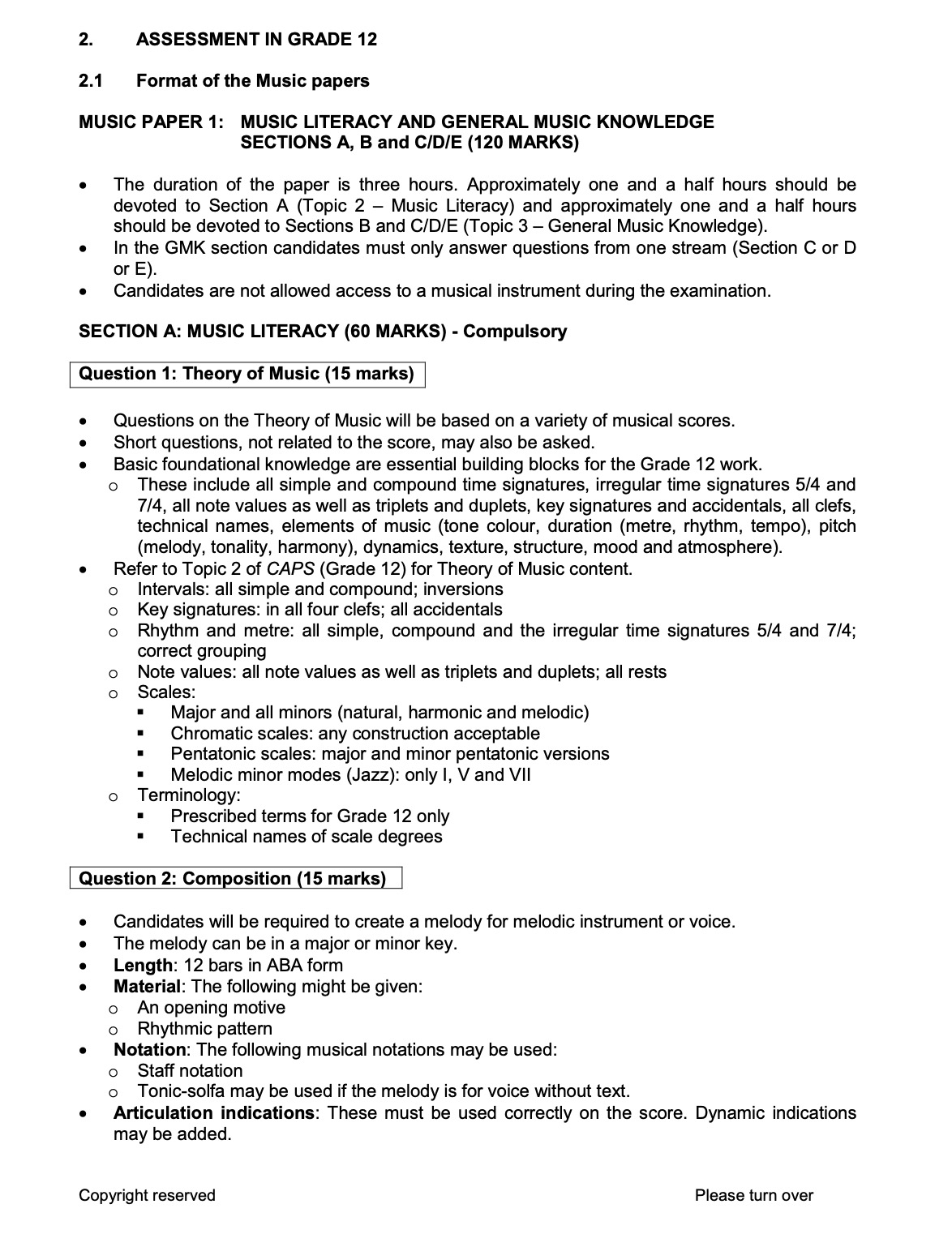
Paper 1: Music Literacy and General Music Knowledge

3 Hours 120 Marks

Tests your theoretical knowledge and your understanding of music history and styles, divided into compulsory and choice-based sections.

Section A: Music Literacy (60 Marks) Theory and Composition covering notation, complex rhythms, intervals, and harmonic progressions. Melody Writing requires creating an original 12-bar melody for a specific instrument or voice, often in ternary (ABA) form. Four-Part Harmony covers completing vocal or instrumental harmonisation using Roman numerals or chord symbols.
Sections B to E: General Music Knowledge (60 Marks) Learners must choose only one stream. Western Art Music (WAM) focuses on Baroque, Classical, Romantic, and 20th Century styles. Jazz covers South African and international jazz history, styles, and key artists. Indigenous African Music (IAM) focuses on traditional music, heritage, and contemporary South African indigenous styles.
Note: You only answer the section for your chosen stream (WAM, Jazz, or IAM) in Sections B to E. Make sure you know which stream your school has prepared you for well before the exam.

Paper 2: Music Comprehension

1½ Hours 30 Marks

A high-stakes listening exam. You respond to questions while an official examination CD is played in the venue.

Aural Recognition Identifying intervals, cadences, and rhythmic patterns by ear.
Music Concepts Distinguishing between different textures (for example, monophonic vs. polyphonic), meters, and compositional techniques like Call and Response.
Contextual Listening Identifying instruments (aerophones, idiophones, and so on) and styles based on the audio tracks provided for your chosen stream (WAM, Jazz, or IAM).